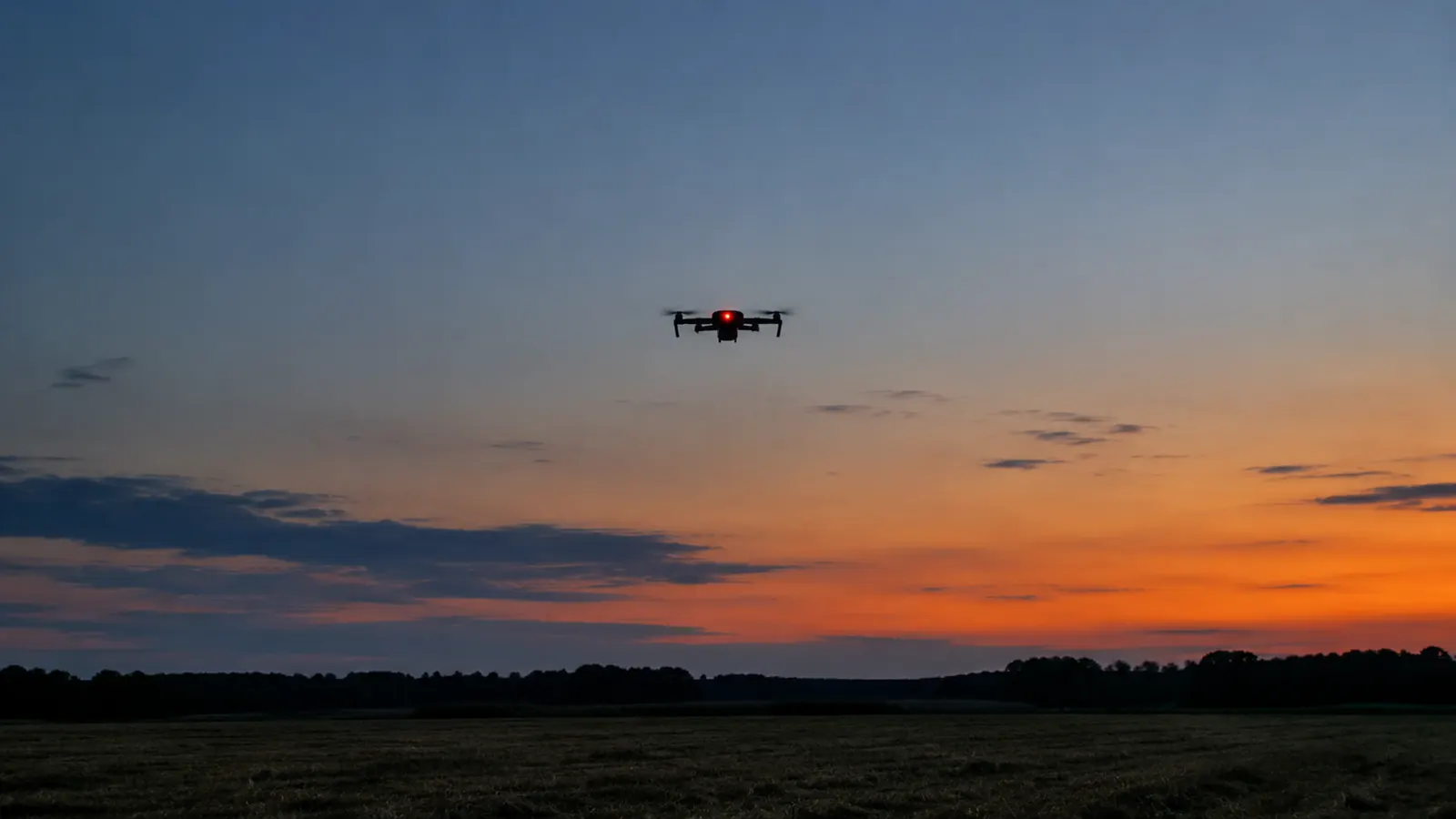
Dusk is the best time to fly, and the worst time to be invisible. The light goes soft, the wind usually drops, and the sky turns colors that a camera sensor handles better than the noon sun. But the same dim light that makes the footage worth shooting also makes your drone hard to see, both for you and for anyone else in the air. That is why I put a VIFLY strobe on my Mini 4 Pro about eighteen months ago, and it is the reason I still fly most of my evening sessions without white-knuckling the sticks.
The strobe does one job. It makes the drone visible. It will not improve your footage, it will not extend your battery, and it will not keep you legal by itself. What it does is turn a small drone into a blinking dot you can track against a treeline, and it gives other pilots something to see when they are looking for traffic. This guide walks through the whole routine, from charging the light to landing it in the dark, the way I actually do it before every twilight flight. If you have been skipping dusk flights because you cannot keep the drone in sight, this is the fix.
The strobe I keep on every dusk flight
The VIFLY anti-collision strobe mounts in under a minute, runs for hours on a charge, and is bright enough to track against a dark treeline. It is the first thing I pack when the forecast says clear evening skies.
Amazon Check Today's Price on Amazon →Step 1: Know the Rules and Pick Your Window
Before you mount anything, check what the rules say where you fly. In the US, the FAA requires anti-collision lighting for night flights, and a strobe like the VIFLY is the standard way to meet that for a sub-250-gram drone. Dusk is a gray area in the regs, which is exactly why I treat it as night and light up anyway. If you fly under a waiver or a Part 107 certificate, your requirements may be different, so read your own paperwork before you trust mine. The strobe does not replace the rules, it just keeps you visible while you follow them.
Your local rules matter too. I fly mostly over open farm fields east of Spokane and a public park on the edge of town. Both are fine for twilight flying, but the park has a posted drone policy and the fields have no one around to complain. Check your own spots for posted rules, and check for airspace restrictions in whatever app you use. A strobe makes you visible, it does not make you legal. I have had a deputy drive past while I was packing up, and the only thing that made that conversation easy was that I was clearly following the local rules.
Pick your window before you charge anything. I aim to launch about 20 minutes before sunset and plan to land by the time the sky is fully dark. That gives me the best light for photos and still leaves me a margin of daylight on the way down. If the sun sets at 8:00, I want the props stopped by 8:20, not still flying at 8:40. The window changes every week as the season shifts, so I check the sunset time the morning of the flight and plan around it.
Step 2: Charge the Strobe and Bench-Test It
The VIFLY charges over USB, and the charge lasts longer than any flight I have ever flown. Still, I charge it the night before, the same way I charge the drone batteries and the controller. A strobe that dies mid-flight is worse than no strobe, because you spent the whole flight thinking you were visible when you were not. I keep a spare USB cable in my drone case so I never have to choose between charging the strobe and charging the controller.
The bench test takes thirty seconds. Power it on, watch it blink, and set it down on the table while you walk across the room. If you can see it from across the room in a lit house, it will be visible against a dark field. If it looks weak on the bench, it will look useless in the air. I had one strobe that flickered when the battery got low, and I only caught it because I tested it before a flight instead of after. That test is now part of my routine every single time.
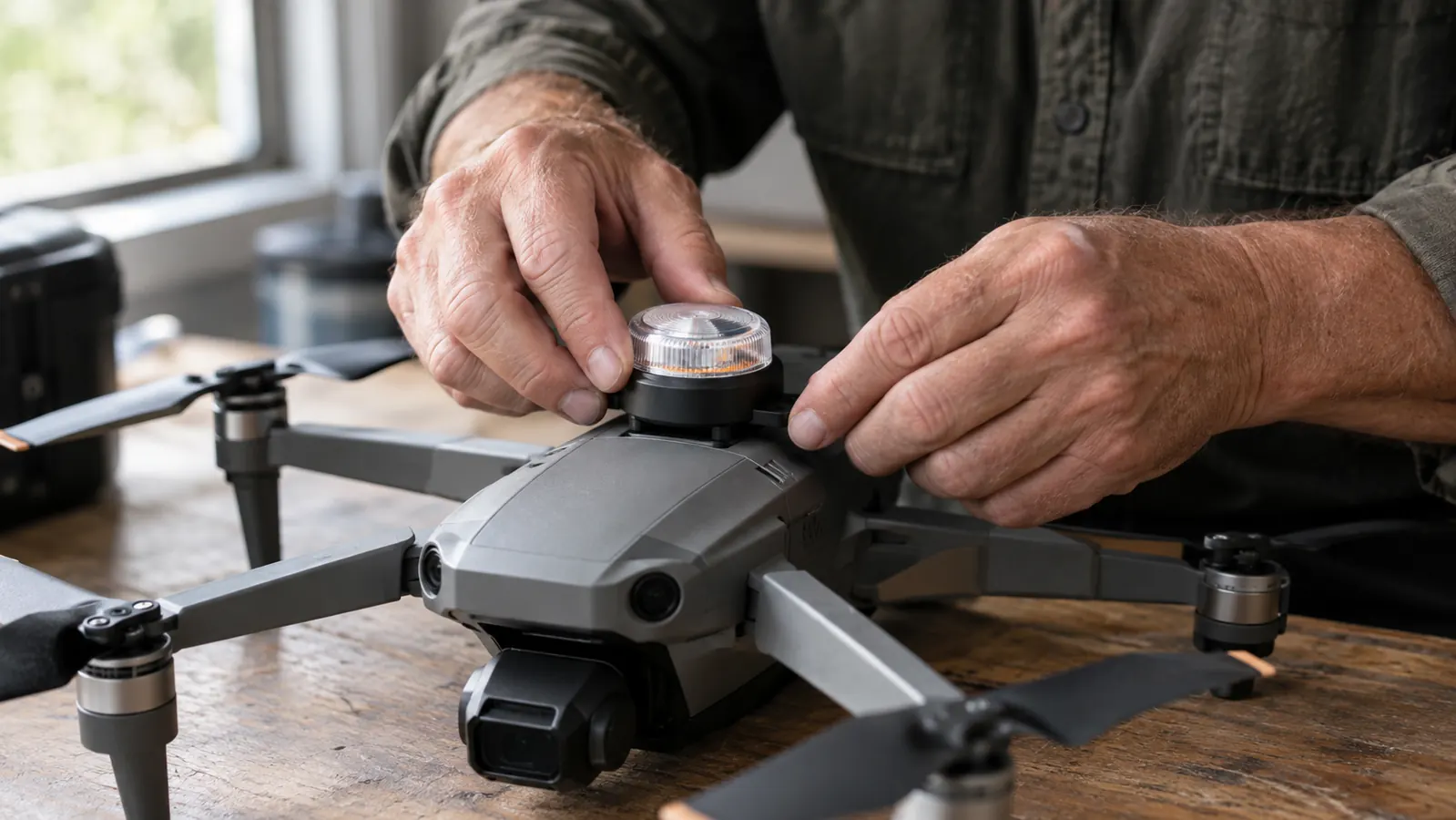
Also check the mount while you are on the bench. The VIFLY comes with a mount that attaches to the drone, and the fit should be snug without forcing. If it wiggles when you push on it, fix that on the ground. You do not want to discover a loose mount at 200 feet. I also give the mount a quick tug after every landing, because vibration can work a mount loose over a season even when it felt tight at first.
Step 3: Mount It With the Light Facing Forward
Mounting is the part most people get wrong, and I did too the first time. The strobe has a bright side and a dim side, and the bright side needs to point where the drone is going, not back at you. On my Mini 4 Pro, I mount it so the light faces forward and slightly up, which makes it visible from the ground and from the air at the same time. If you mount it facing straight up, you get a great beacon for yourself and almost nothing for another pilot at your altitude.
The mount should not touch the gimbal or the camera. That sounds obvious, but I have seen photos of drones with the strobe mount pressing on the gimbal arm, which makes the camera twitch in flight. Leave a finger's width of clearance and check the gimbal's full range of motion before you power up. Move the gimbal through its full sweep on the bench and watch for any contact. If the mount is in the way, re-seat it before you fly, not after you see the jello in your footage.
Balance matters less on a small drone than you would think, but it still matters. A strobe weighs almost nothing, so it will not change your flight characteristics much. What it can do is catch prop wash and vibrate if the mount is loose. If you hear a new buzz on takeoff, land and re-seat the mount. I also make sure the strobe is the last thing I attach, so it never gets in the way while I am setting up the controller and the tablet.
Step 4: Pick the Mode and Set It Before Launch
The VIFLY has different light modes, and the one you want depends on what you are doing. For general flying at dusk, a steady or slow blink is easier to track than a fast strobe, because your eye can lock onto a repeating pattern. For a longer flight where you want maximum visibility, use the brightest setting and accept that it will drain the battery a little faster. I keep mine on the slow blink for most flights and switch to the brighter mode only when the sky is darker than I expected.
Set the mode on the ground, not in the air. Fumbling with a tiny button while you are also watching the drone is how you end up with the light off at the exact moment another pilot needs to see you. I set mine to the mode I want, then leave it alone for the whole flight. The switch is small and the modes are easy to cycle past by accident, so I check it twice on the ground before takeoff.
One more thing: the light is for other people as much as for you. A blinking strobe is easier for another pilot to spot than a steady light, because the human eye picks up changes in light better than a constant source. That is why I choose a blink pattern for every dusk flight, even when the sky is still fairly bright. The whole point of the exercise is to be seen, and a pattern that repeats is the most reliable way to get that done.
Step 5: Fly the Session and Land Before the Dark
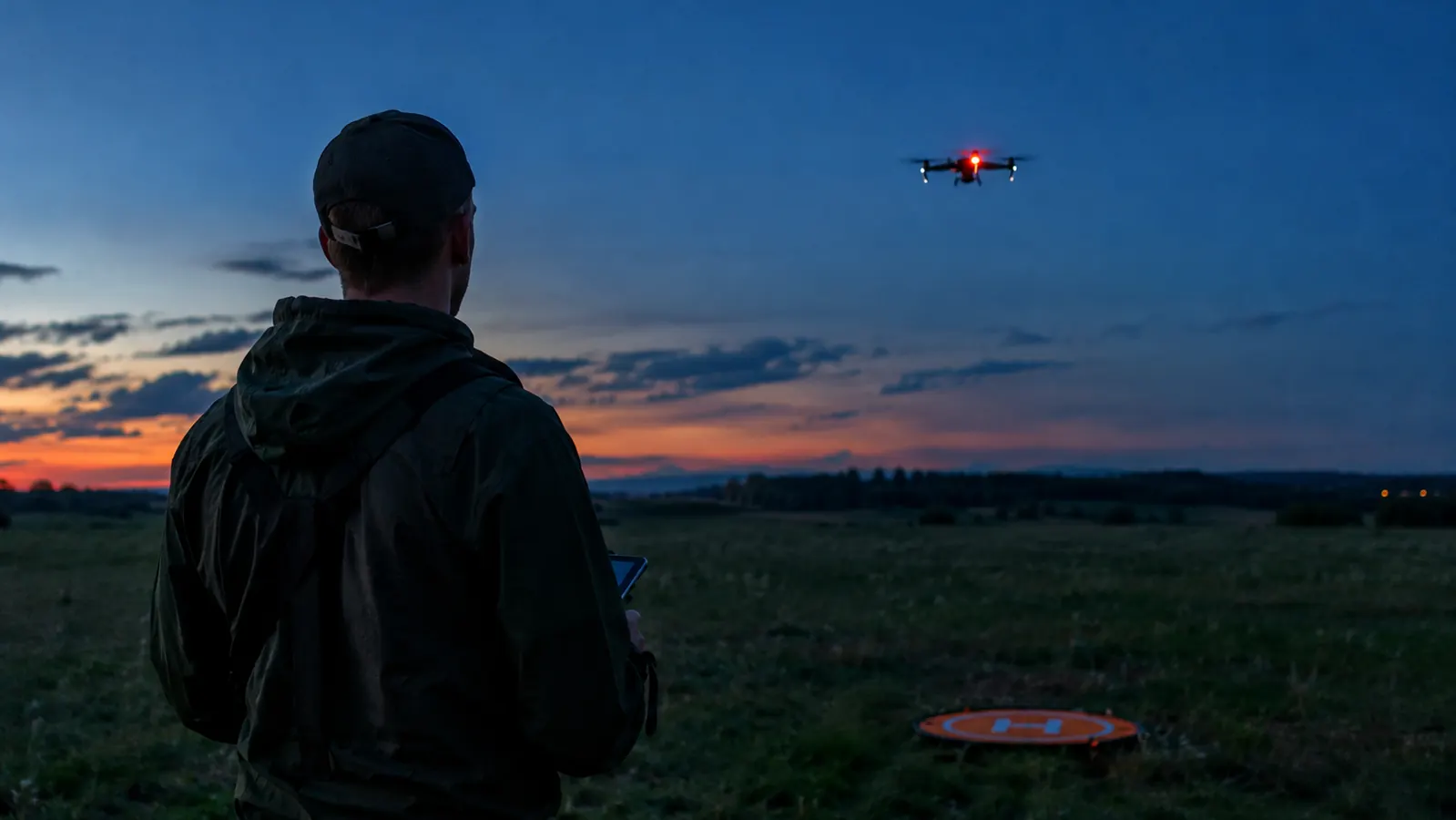
Pre-flight is the same as any flight, plus one extra check. I lay out my landing pad, power the drone, confirm the strobe is blinking from the ground, and only then take off. If the strobe is dark, I land immediately and fix it. I have never had to, but the check costs five seconds and the failure mode is serious. I also confirm the strobe is still blinking after the first minute of flight, because that is when a loose mount or a bad connection usually shows up.
Keep the drone closer than you would in daylight. At dusk, depth perception gets worse, and a small drone against a dark treeline is easy to lose even with a strobe. I keep my twilight flights within about 300 feet and below the treeline of the hills I fly near. That is a personal limit, not a rule, but it has kept me out of trouble. The footage is a little less dramatic than a wide shot over the valley, but the drone comes home every time.
Land with light to spare. The sky changes faster than you expect it to, and the last ten minutes of a twilight flight are the hardest to judge. I plan my landing for when the sky is still a little blue, not when it is fully black. If the battery warning comes on early, I land early. The footage is never worth a flyaway. I have packed up in the dark more than once, and every one of those flights would have been better if I had started the landing a minute sooner.
What Else Helps
A strobe is the main thing, but a few other pieces make dusk flying easier. I fly with an iPad mini on a tablet holder so I can see the screen without squinting at a phone. I use a landing pad on rough grass so the props stay clear of debris. And I keep a small flashlight in my bag for packing up after the flight, because the parking lot is darker than the field. None of these are as important as the strobe, but they all make the routine smoother. The strobe keeps you visible; the rest keeps you comfortable.
The other habit that helps is telling someone where you are flying. Tara knows the field I usually use, and I text her when I launch and when I land. It takes ten seconds and it means someone will notice if I am not back. That is not gear advice, but it is the advice I would give anyone who flies alone at dusk. The strobe handles the visible part of safety, and the text handles the part nobody sees.
The strobe is not for your footage. It is for the other pilot who did not see you coming.
Flying at dusk is my favorite way to end a weekend, and the strobe is the reason I can do it without stress. The routine takes about five minutes once you have done it a few times: charge, mount, set the mode, check the light, fly, and land with margin. None of it is complicated, and all of it is worth doing. If you are on the fence about adding a light to your drone, this is the one piece of gear I would buy before any filter or extra battery. A dusk flight you can see is a dusk flight you can enjoy, and that is the whole point.
Make your next dusk flight one you can actually see
The VIFLY strobe is the cheapest insurance you can bolt onto a drone. Mount it, charge it, set the mode, and fly with the confidence that other people can see you coming.
Amazon Check Today's Price on Amazon →