
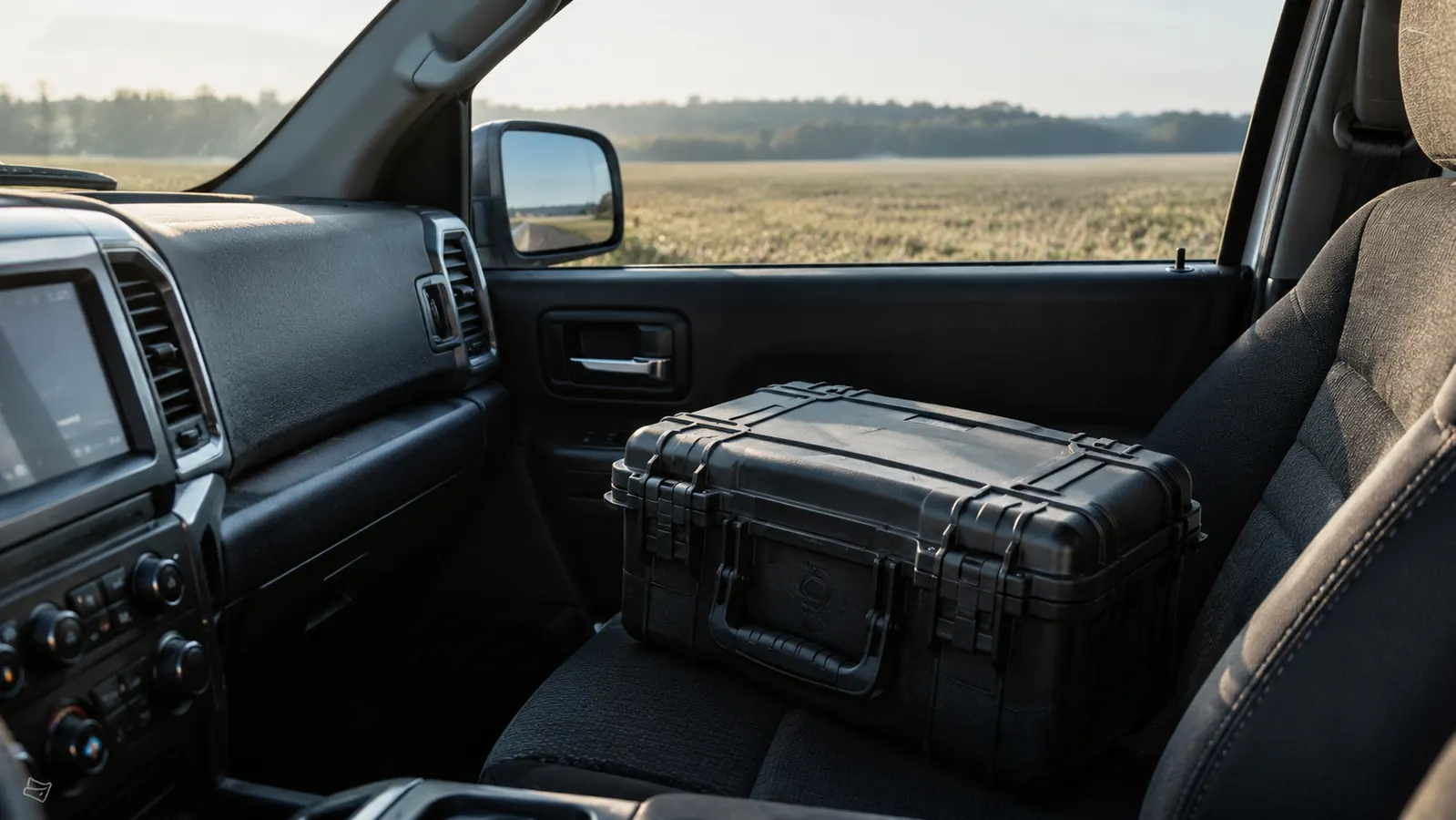
Two years ago I crushed my drone's soft shoulder bag under a sliding toolbox in the back of my work truck. The drone survived, barely, because the bag happened to be on top of a jacket. The bag did not survive. I ordered the JSVER hard case for the DJI Mini 4 Pro that same week, and it has lived in that truck ever since, through two Idaho winters, a summer of 100 degree afternoons, and more gravel roads than I can count. This is the long review, the one you can only write after hauling a case around for two years instead of two days.
I am not gentle with gear. I am an HVAC service tech, I drive a work truck that doubles as a storage unit, and my drone is a weekend hobby, not a piece of studio equipment. The Mini 4 Pro rides to the field in this case, sits on the tailgate while I fly, and rides home again. I have dropped the case on gravel, kicked it out of the back seat, and stacked tools on top of it. Two years in, the drone still flies like the day I bought it.
The Quick Verdict
The JSVER hard case has protected my Mini 4 Pro through two years of truck abuse, farm fields, and lake trips. It is not the lightest way to carry a drone, and the foam layout assumes you bring the RC-N2 controller, but it does the one job that matters: the drone comes out of the case the same way it went in.
Amazon Check Today's Price →Two years of hard use and the drone still looks new
If you carry your Mini 4 Pro in a truck, a backpack, or anywhere it can get bumped, the JSVER hard case is cheap insurance. The foam cutouts hold the drone, the controller, and the spare props in place, and the shell shrugs off the drops I keep giving it.
Amazon Check Today's Price on Amazon →How I've Used It
I bought the JSVER case at the same time as the Mini 4 Pro, back when the drone was still new in the box. Before that I carried my old Mavic Air 2 in a soft shoulder bag, and I treated it like it was made of glass. The bag lived in the passenger footwell, never got thrown anywhere, and still managed to get crushed the one time I slid a toolbox across the truck bed. The lesson stuck: soft bags protect against nothing when the thing on top of them weighs forty pounds.
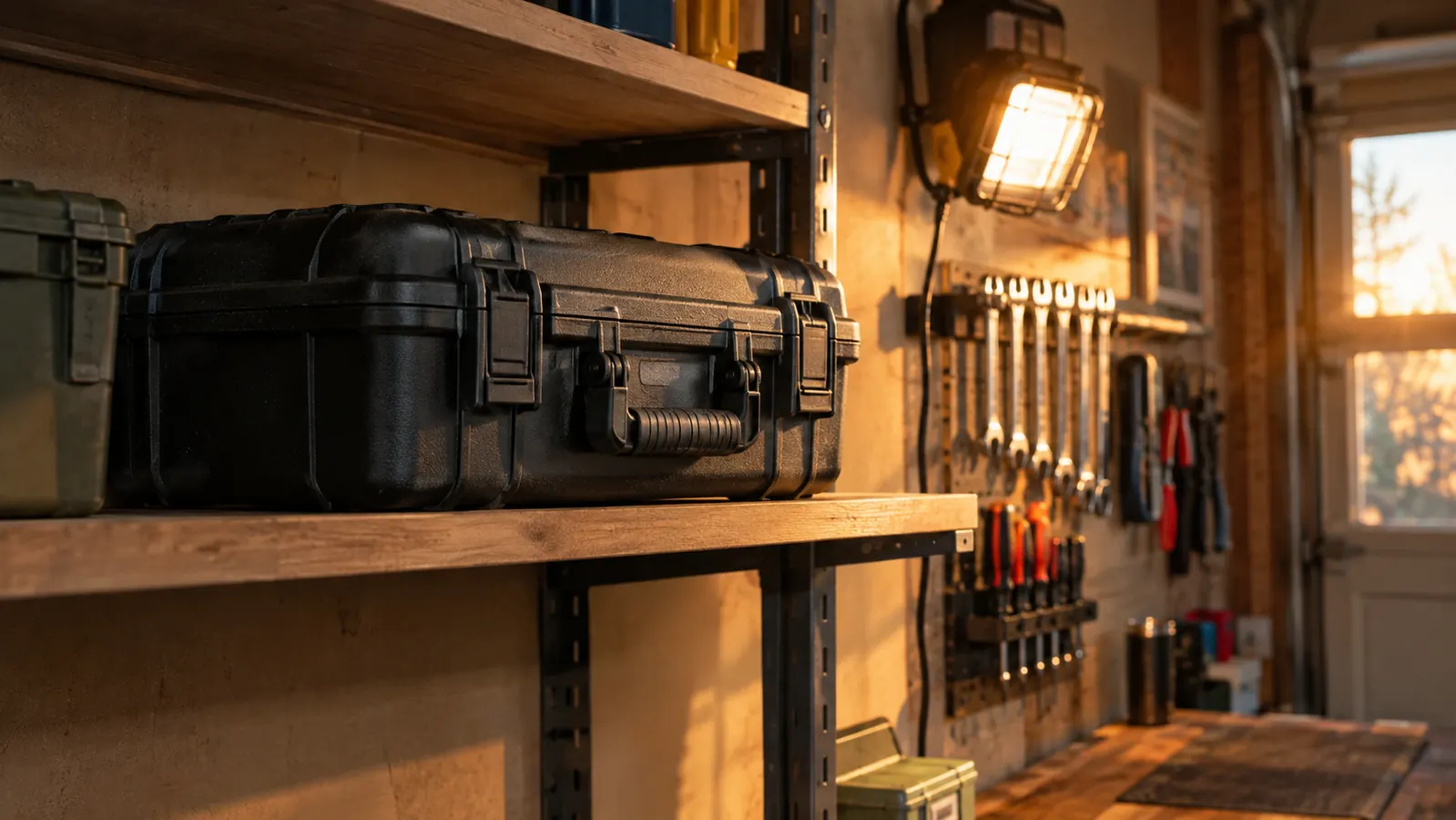
Since then the JSVER case has spent roughly two years in the back of my truck. It rides behind the driver's seat on short trips to the park east of town, and in the bed on longer runs to the Palouse hills or the lakes in north Idaho. It has been rained on, frozen, and left in a hot cab while I worked a service call. The case has also spent nights in the garage on a shelf above the workbench, where it shares space with refrigerant gauges and a torque wrench. Nothing has ever fallen on it there, but I do not worry about it the way I used to worry about the soft bag. I have opened it in a gravel lot, on a dock, and on a tailgate covered in pine needles. The drone goes in, the case closes, and I stop thinking about it until I need it again.
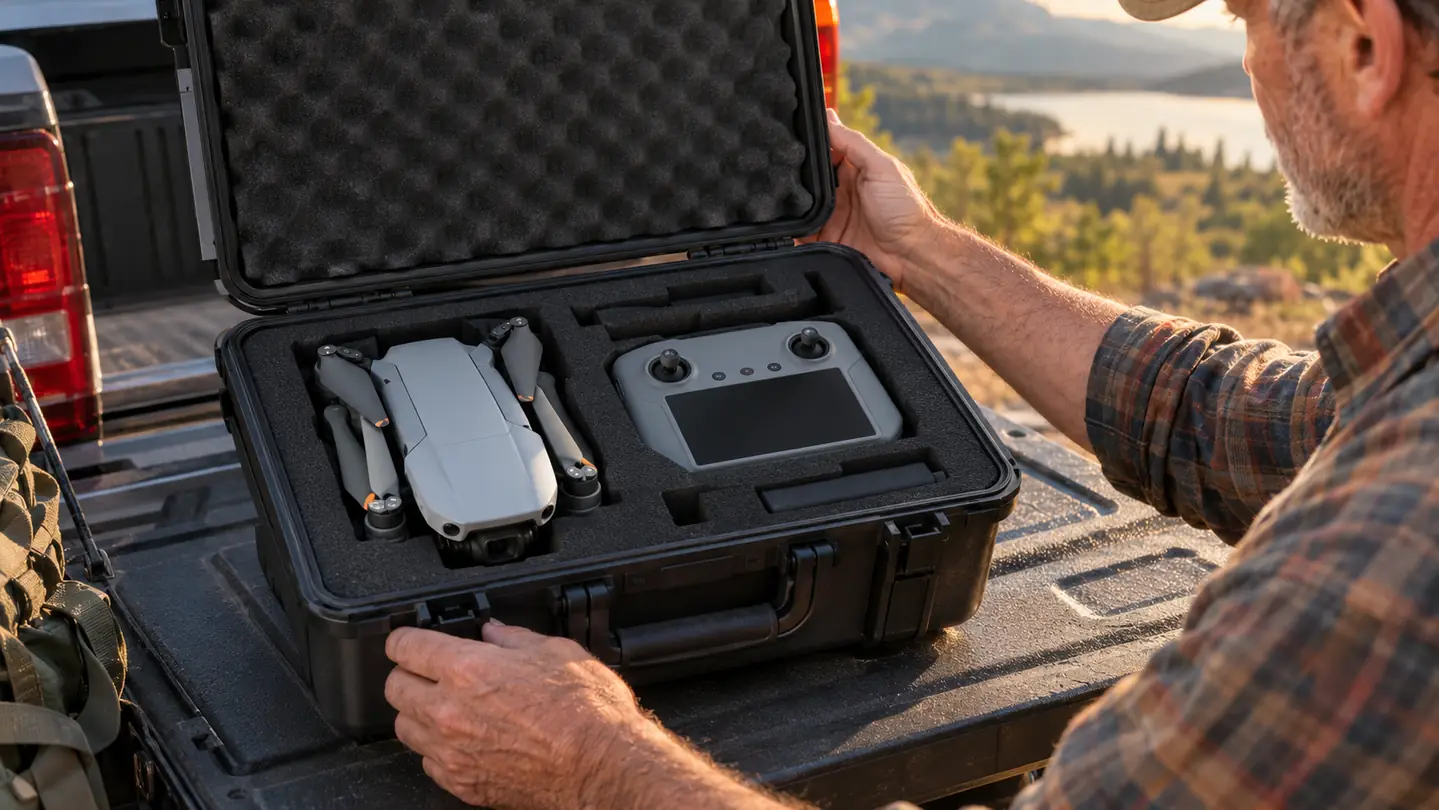
The routine is the same every time. Case opens flat, drone comes out of its cutout, I check the props and battery, and the empty case goes back on the tailgate as a staging table. When the flight is done, the drone goes back in the same cutout, the controller goes in its slot, and the case closes with two latches. Two years of that routine and nothing about it has worn out or loosened up.
What Fits and What Doesn't
The case is cut for the Mini 4 Pro Fly More setup, which is the main reason I picked it. The drone sits in its own molded foam pocket with the props on. The RC-N2 controller has a dedicated slot, and there is room for the spare prop set, the charging cables, and a small stack of batteries. The spare prop set sits in a small cutout next to the controller, and the cables tuck into the gap between the battery slots. It is a tight fit, but a deliberate one. I fly with the RC-N2 and my phone in the controller clip, and everything fits with the case closed flat.
The foam is the part I notice most. It is the firm, dense kind that holds the drone without squeezing it, and the cutouts are deep enough that nothing shifts when the case gets tossed around. I have opened the case after a rough gravel road and found the drone exactly where I left it. That sounds like a small thing until you have opened a soft bag and watched your drone roll out onto the tailgate.
The shell is EVA, the same material as a lot of hard camera cases, but molded thinner to keep the weight down. It flexes a little when you squeeze it, and that flex is what saves the drone when the case takes a hit. I have dropped this case onto gravel from waist height and the only mark is on the shell itself. The latches are simple plastic over-center clips, and two years in, both still close with a clean snap.
The Truck Test: Two Years of Drops and Rattles
The honest test for a drone case is not how it looks on a shelf. It is what happens after two years of being treated like a toolbox. My case has been slid across a truck bed, had a cooler set on top of it, and bounced down a washboard road for an hour. The drone has never come out damaged, and I have never opened the case to find a prop bent or a gimbal cover popped off. The latches have held, the foam has kept its shape, and the drone has never once arrived at the field with something out of place.
The one time the case really earned its keep was last fall. I had the case on the tailgate while I packed up, and a gust of wind caught the truck door and knocked the case onto the gravel. It landed on a corner, bounced once, and lay there. I opened it expecting the worst. The drone was fine, the props were fine, and the only evidence was a scuff on the shell. That single drop paid for the case in my mind.
The one thing that did wear out was the shoulder strap clip. The strap itself is fine, but the plastic clip that attaches it to the case got stiff after about a year of being shoved behind the seat. I stopped using the strap and just carry the case by the handle, which is molded into the shell and has held up without any sign of cracking.
Temperature is the other thing I can speak to after two years. The case has sat in a truck cab through a Spokane winter and a July heat wave. The EVA shell does not insulate, so the drone gets cold or hot along with the truck, and I always pull the batteries out when I park it. But the case itself has not warped, the foam has not crumbled, and the latches still line up. For a case that lives in a vehicle, that matters more than any drop test.
What I'd Change
Nothing is perfect, and this case has two things I would fix if I could. The first is the shoulder strap clip I mentioned, which is the only part that has aged poorly. The second is the layout: the case is clearly designed around the Fly More kit, and if you carry extra accessories like a tablet holder or a filter set, you will be stacking them on top of the foam instead of tucking them into a pocket. My Hanatora tablet holder and my NEEWER filters ride loose on top, and they shift around a little in transit.
It is also not the smallest case you can buy. A soft bag packs flatter and slides behind a seat more easily, and if you are the kind of pilot who carries the drone in a backpack all day, the hard shell will feel bulky. I made that trade on purpose, because my problem was never carrying the drone. It was everything else that happened to it in the truck.
The Alternatives I Considered
Before I settled on this case, I looked at the usual options. The soft shoulder bag was what I already had, and it failed the one test that mattered. A backpack-style case is great if you hike to a launch site, but I fly from the tailgate, and a backpack just means one more thing to dig through. I also considered the official DJI carrying bag, but it is a soft bag with a hard insert, and after the toolbox incident I wanted a real shell between the drone and the world. That turned out to be the right call, because the soft bag was never going to survive the truck.
The comparison I keep coming back to is hard case versus backpack, and I have now used both. The backpack wins on comfort and capacity. The hard case wins on protection and speed, because it opens flat and everything is exactly where it was last time. For how I fly, mostly from the truck and the tailgate, the hard case is the right call every single week.
What Two Years Taught Me
The biggest lesson from two years with this case is that protection is a habit, not a feature. The case does its job every time, but only because I have a place for everything and I put everything back in that place. The foam layout makes that habit easy, because each item has one obvious home. When the battery dies mid-flight and I need to swap it fast, I know exactly where the spare is without digging. That kind of calm is hard to put a number on, but it is why the case still sits in the truck every single day.
The second lesson is that a case you will actually carry beats a case that stays home. The JSVER case is not the lightest option, but it is light enough that I never leave it behind, and that matters more than an ounce or two on the spec sheet. A drone that rides in the truck gets flown. A drone that has to be carefully packed and unpacked tends to stay home. I fly more because the case makes it easy.
What I Liked
- The drone sits in a deep, dense foam cutout and never shifts, even on washboard gravel roads.
- The EVA shell has taken two years of drops, stacked tools, and truck-bed abuse without the drone ever getting damaged.
- The layout fits the Mini 4 Pro with props on, the RC-N2 controller, spare props, and a couple of batteries.
- It opens flat and doubles as a clean staging surface on the tailgate.
- Two years in, the molded handle and both latches still work like new.
Where It Falls Short
- The shoulder strap clip stiffened up after about a year, and I stopped using the strap.
- There is no dedicated pocket for extras like a tablet holder or filters; they ride loose on top of the foam.
- It is bulkier than a soft bag if you need to pack it flat in a backpack.
The drone goes in, the case closes, and I stop thinking about it until I need it again. Two years of that is worth more than any drop test.
Who This Is For
This case is for the pilot who carries a drone in a vehicle, on a tailgate, or anywhere it can get bumped. If you fly from the bed of a truck, keep the drone in a garage that shares space with tools, or take it to a lake cabin on a rough road, the hard shell is the difference between unpacking a drone and unpacking a problem. It is also for the pilot who wants the same routine every time: open, fly, close, done. If you recognize yourself in the phrase 'the drone lives in the truck,' this is your case. If you fly from a backpack, read the next section before you buy.
Who Should Skip It
Skip it if you hike to launch sites and need the drone in a backpack, because the hard shell is heavy and does not pack flat. Skip it if you carry a full accessory kit, because the foam layout only covers the basics and the extras will rattle around on top. And if you already have a hard case that fits your drone, there is no reason to buy a second one. The JSVER case is a good case, not a fix for a careless pilot.
Still the case I'd buy again tomorrow
After two years in my truck, the JSVER hard case has done exactly what I asked of it: the Mini 4 Pro comes out the same way it went in. If you are tired of fishing foam crumbs out of a soft bag, this is the upgrade.
Amazon Check Today's Price on Amazon →