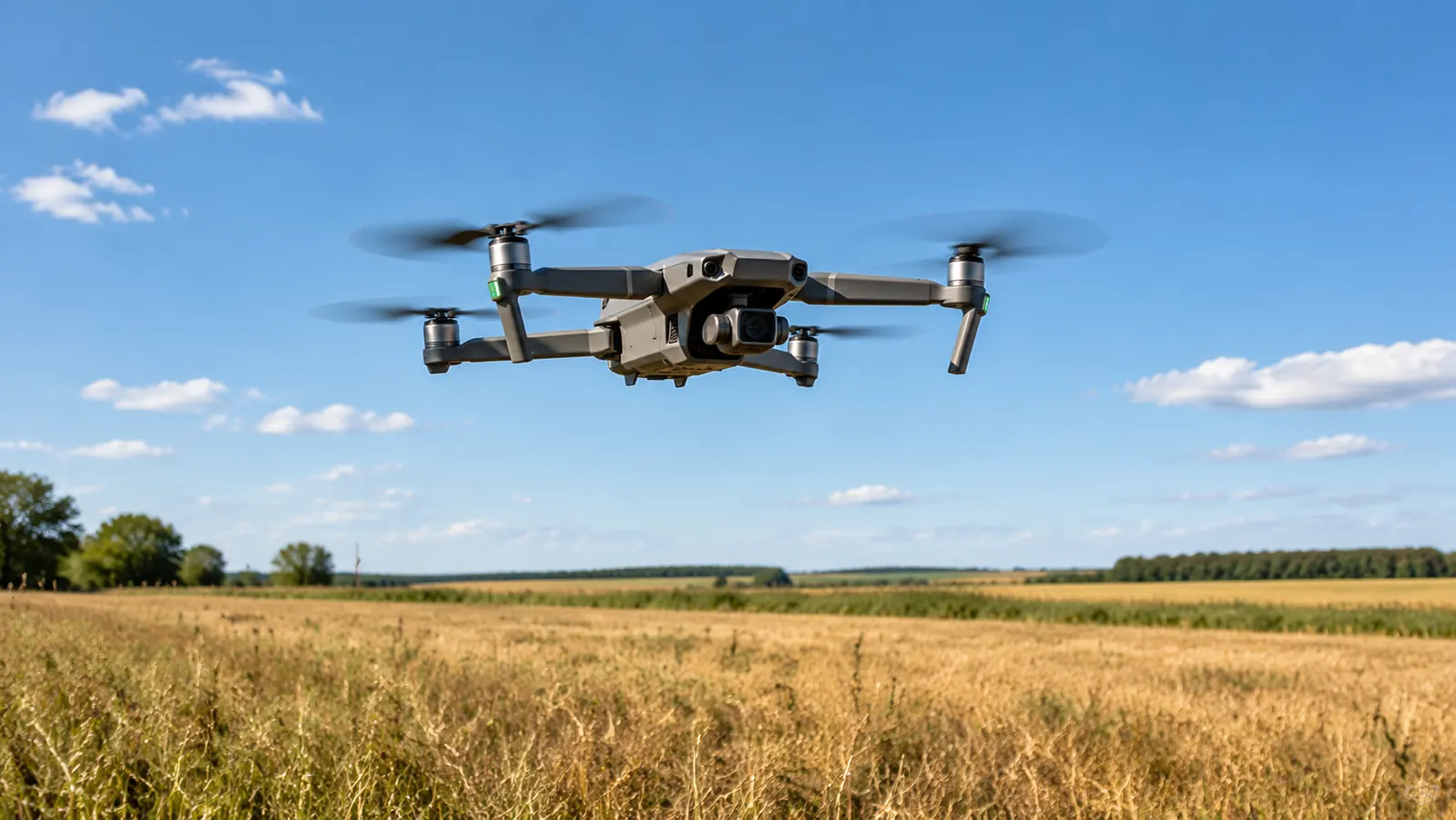
I spent three weekends flying the same stretch of farm field and the same lake shoreline with my DJI Mini 4 Pro, first with the bare lens and then with the NEEWER ND and CPL filter set. Same battery, same route, same time of day, as close to the same light as I could get. The short answer: if you shoot video in daylight, the filters are worth having on the gimbal. But the bare lens is not useless, and there are a couple of situations where I would still take it off.
This is not a lab test. I am an HVAC service tech who flies on weekends, not a cinematographer. I wanted to know whether a filter set actually changes what my footage looks like, or whether it is one of those accessories you buy and leave in the case. So I shot the same scenes back to back, checked the shutter speed the camera chose, and looked at the clips on a decent monitor instead of a phone screen.
The first test was a Saturday in late June, out on the field east of town where I do most of my flying. I put the drone up at 11:45 in the morning, full sun, no clouds, and shot a slow pan across the dry grass with the bare lens. Then I landed, snapped on the ND16, and flew the exact same route with the same stick inputs. The difference showed up before I even got home: on the monitor, the bare lens footage looked like a series of still photos stitched together, and the water in the irrigation ditch flickered. The ND16 footage had that smooth, continuous look. I repeated the test the next weekend at a lake in north Idaho, and again in mid-July when the glare was at its worst. I also made the mistake I figure most people make: I left the ND64 on at dusk one evening and spent twenty minutes wondering why the footage looked like it was shot through a dirty window. The camera had pushed the ISO up to 1600 to compensate, and the shadows were full of noise. That is when I started checking the light before I launch, and it is why the bare lens still has a place in my bag.
Short version: The NEEWER ND and CPL set fixes the two problems that ruin daylight drone video: it brings shutter speed down to the 1/60 rule and it cuts water and foliage glare. The bare lens wins only when the light drops or you want the sharpest possible still.
Daylight video looks smooth with the ND set on
The 4-pack covers ND8, ND16, ND32 and ND64, plus a CPL for glare. If you shoot your Mini 4 Pro in the middle of the day, this is the fix.
Amazon Check Today's Price on Amazon →| NEEWER ND & CPL Set | Bare Lens | |
|---|---|---|
| Shutter speed at midday | ND16 or ND32 brings it down to 1/60, smooth motion | 1/2000 or faster, stuttery pans, flickering water |
| Water and foliage glare | CPL cuts reflections, you can see into the water | Hot blown-out patches, no way to remove in post |
| Still photos | Sharp, but you are stacking glass in front of the sensor | Maximum sharpness, no extra glass, simpler exposure |
| Low light and overcast | You lose a stop or two, need to drop to ND8 or remove it | Keeps the sensor fast, cleaner shadows |
| Setup time | About a minute to swap and check the fit | Nothing to install, just fly |
| Cost to replace | One filter is cheap if you drop the drone in a field | The bare lens is part of the camera, expensive to repair |
| Learning curve | Four filters to pick from, match the ND to the light | Nothing to choose, nothing to forget |
| Best for | Daylight video, lakes, snow, any bright reflective scene | Golden hour, overcast days, stills, night flying |
Where the NEEWER Set Wins
The biggest difference is shutter speed, and it is not a subtle difference. On a bright afternoon the Mini 4 Pro bare lens wants to shoot at 1/2000 or faster to avoid blowing out the highlights. I watched it sit at 1/4000 on the lake in mid-July, which is about as frozen as video gets. Video at that speed looks like a slideshow when you pan: every frame is perfectly sharp, so motion has that stuttery, stop-motion feel, and water turns into a flickering mess. With the ND16 on in the same light, the camera settled around 1/60, which is the classic 180-degree shutter rule for 30 fps. Pans look smooth, water looks like water, and the footage has that slight motion blur that reads as cinematic rather than harsh. The rule is simple: double your frame rate for the shutter speed. At 30 fps you want 1/60. At 24 fps you want 1/50. The bare lens cannot get there in daylight without stopping down, and the Mini 4 Pro has a fixed aperture, so the ND filter is the only way to do it. I check the shutter speed on the iPad mini in the Hanatora holder before every pan. It is a habit I picked up after that first test, and it saves me from guessing: if the number is above 1/120, the filter is wrong for the light.
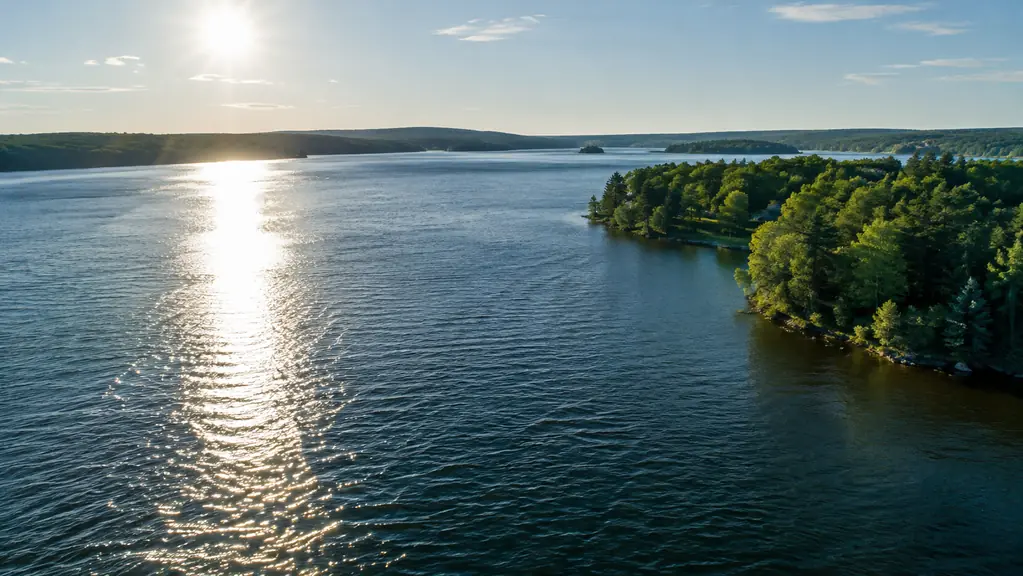
The CPL is the other half of the win, and it took me a while to use it right. I flew the same lake shoreline on three different days, and with the CPL on, the glare on the water dropped enough that I could see the rocks and the bottom in the shallows. Without it, the surface was a blown-out white sheet. The same effect showed up on wet grass and on the hood of my truck after a rain. One thing I learned the hard way: the CPL has to be rotated to match the angle of the light. The first time I used it, I snapped it on and flew, and the footage looked fine until I turned the drone crosswise to the sun, and then half the frame went dark. You have to rotate the ring until the glare drops and the sky stays even, and you have to recheck it every time you change heading. It is a small thing, but it is the difference between footage that looks graded and footage that looks like a mistake.
The set also covers the range you actually need. ND8 for overcast days, ND16 and ND32 for normal daylight, ND64 for bright snow or beach sand. I have used all four in the year I have owned them, which is more than I can say for most of the accessories in my gear bag. The magnetic mount on the NEEWER set snaps on and off fast, which matters when the sun ducks behind a cloud and you want to swap from ND32 to ND16 without landing. I keep the ND16 and ND32 in the two little slots in my JSVER hard case, and the whole set rides in the case lid so I never have to dig for it. The one thing I would change is the storage: the filters are small, and if you drop one in dry grass you will be on your hands and knees for a while. I dropped the ND64 in the field in July and found it by luck, ten minutes later, with the sun going down.
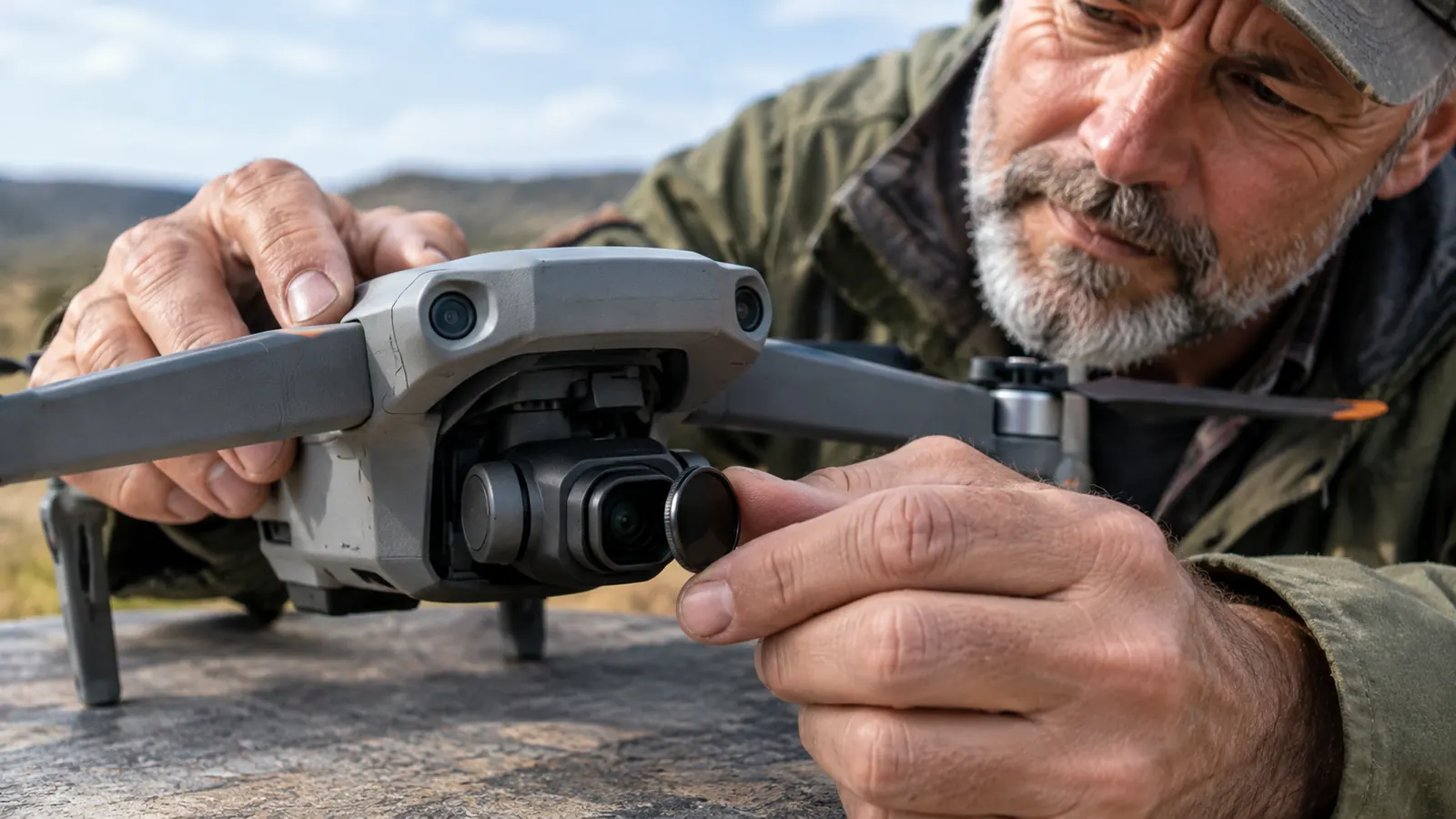
Where the Bare Lens Wins
Take the filters off when the light drops. On overcast evenings, or in the shade of the trees at the park, the bare lens keeps the sensor fast and the shadows clean. With an ND filter on in low light, the camera pushes the ISO up and the footage gets noisier. I learned this on a Tuesday evening in September, flying the park east of town. The sky was flat gray, I had the ND8 on out of habit, and the camera was sitting at ISO 1200 by the time I landed. The footage was usable, barely, but the shadows had that grainy crawl you cannot fully remove in editing. I flew the same park the next evening with the bare lens and the ISO stayed around 400, which is a difference you can see. Now I check the light before I launch: if the sky is flat gray, or the sun is within an hour of the horizon, the filters stay in the case.
The bare lens also wins for still photos. I shoot mostly video, but when I want a sharp still of the Palouse hills, I take the filter off. Even a good piece of glass in front of the sensor costs you a little contrast and a little sharpness, and for a still you can fix shutter speed in the camera without the filter. Same for flying at dusk with the VIFLY strobe on: the bare lens lets the camera gather every bit of light, and the strobe does the visibility work. I have flown that setup over the field at twilight maybe a dozen times, and the footage has a clean, open look that the filtered clips cannot match. There is also the simple fact that the bare lens is one less thing to fuss with. No rotating a CPL ring, no checking which filter is on, no risk of a filter working loose. Some flights are better when the only thing between the sensor and the scene is air. I flew the older Mavic Air 2 for four years before I switched to the Mini 4 Pro, and it had the same fixed-aperture problem. The difference is that the Mini 4 Pro is small enough that the filter set actually rides in the case with me, so I use it. With the Air 2, the filters lived in a drawer.
The bare lens froze every frame at 1/2000 and the water flickered like a bad fluorescent light. The ND16 brought it down to 1/60 and the same shoreline looked like video.
Who Should Buy Which
Buy the NEEWER set if you shoot video in daylight, especially around water, snow, or anything reflective. That is most weekend flying in eastern Washington from spring through fall. I fly the Palouse hills and the lakes in north Idaho, and from May to October the sun is bright enough that the bare lens cannot get to 1/60 without blowing out the sky. The set costs less than a single DJI-brand filter, and the magnetic mount makes it easy to use in the field. I keep the ND16 and ND32 on the two most-used slots in my JSVER hard case and the whole set travels with me. I used the ND64 on a bright day in February when the fields were snow-covered, and it was the only filter that kept the shutter near 1/60 without blowing out the white. If you fly in winter, that one filter is worth the set on its own. If you are new to filters, the 4-pack is a reasonable place to start because it covers the range instead of forcing you to guess which single ND you need.
Skip it, or leave it in the case, if you only fly at golden hour, shoot mostly stills, or fly in overcast weather. The bare lens is genuinely better in those conditions, and you will not miss the filters. If you are on the fence, start with the bare lens, shoot a pan across a lake at noon, and look at the footage on a real monitor. That one clip will tell you which side you are on. And if you do buy the set, give yourself a couple of flights to get used to the CPL rotation and the filter choice. My first filtered flight was a mess of dark frames and overexposed sky because I did not match the filter to the light. By the third flight I could look at the sky, pick the filter, and not think about it again.
Same drone, smoother daylight footage
The NEEWER ND and CPL 4-pack is the cheapest upgrade I have made to my Mini 4 Pro. Check the current price on Amazon and see if it fits your flying.
Amazon Check Today's Price on Amazon →