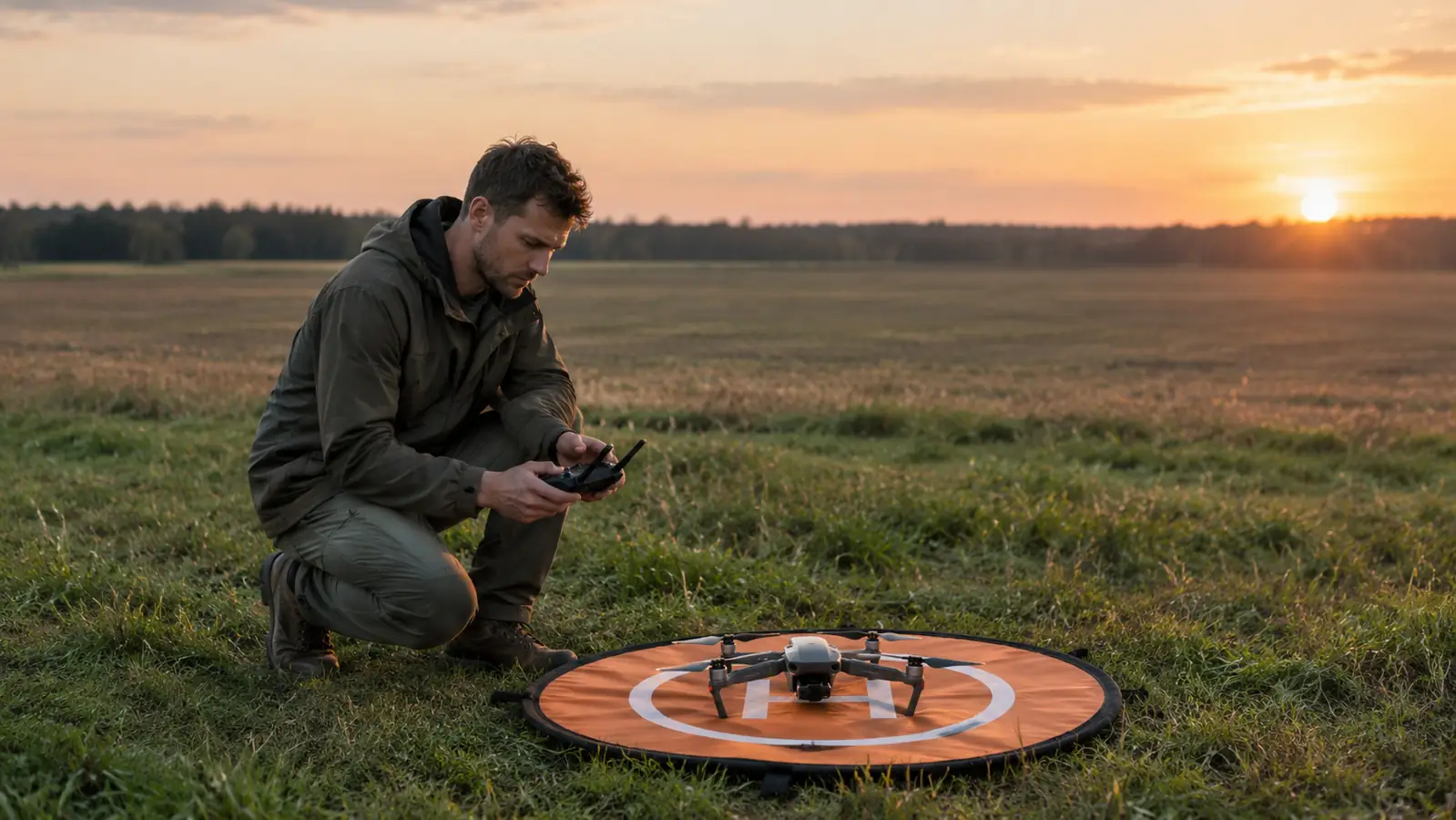
Here's what nobody tells you about a drone landing pad: it is not a magic surface. It is a piece of fabric with a printed target and four small stakes, and it has real limits. I learned most of those limits the hard way, usually in a gust of wind over a farm field east of Spokane, or on a hard-packed gravel lot where the stakes refused to bite. But after two years with the YINGJEE 22 inch pad, I still pack it for every single flight. That's the honest part. It frustrates me about once a month, and I'd still buy it again tomorrow.
Why do you even need a landing pad? Because the ground is never as clean as you think it is. Bare grass looks fine until you're hovering three feet up and the downwash from the props starts throwing dust, loose clippings, and the occasional pebble straight into the rotors. On a dry summer day in the Palouse, the dirt is so fine it hangs in the air like smoke, and you can watch it settle into every seam of the drone. The YINGJEE pad gives the Mini a clean, level spot to start from and come back to, and it gives me a visual target that doesn't move. That matters more than I expected it to.
The Quick Verdict
A cheap, packable pad that does its job on grass and dirt, as long as you accept the fold lines and stake it down in anything more than a light breeze.
Amazon Check Today's Price →A clean takeoff spot that folds down to nothing
The YINGJEE pad folds small enough to live in my drone bag, and it keeps grass, dust, and sand out of the props. Check today's price on Amazon and see if it fits your setup.
Amazon Check Today's Price on Amazon →How I've Used It
I bought the YINGJEE pad about two years ago, at the same time I bought my DJI Mini 4 Pro. Before that I flew a Mavic Air 2 for four years, and I mostly took off from whatever patch of ground looked acceptable. I got tired of cleaning grass clippings out of the arms and wiping dust off the lens after every flight. The pad was a cheap fix for a problem I had been ignoring for years. It lives in the side pocket of my JSVER hard case now, which is the same case I use to carry the Mini, the RC-N2 controller, and a spare battery. It costs less than a single replacement set of props, and it has saved me from buying several.
My usual spots are open farm fields, a public park east of town, the Palouse hills, and lakes in north Idaho. That means grass, dirt, gravel, and the occasional sandy shoreline. The YINGJEE pad has been used on all of them. In two years it has taken a beating: folded and unfolded hundreds of times, stepped on, rained on, covered in dust, and once left out in the sun for a full afternoon while I shot a lake from every angle. It still works. The printed target is scuffed in one spot where I dropped a battery on it, and the edges have picked up a few snags, but nothing has peeled, torn, or failed.
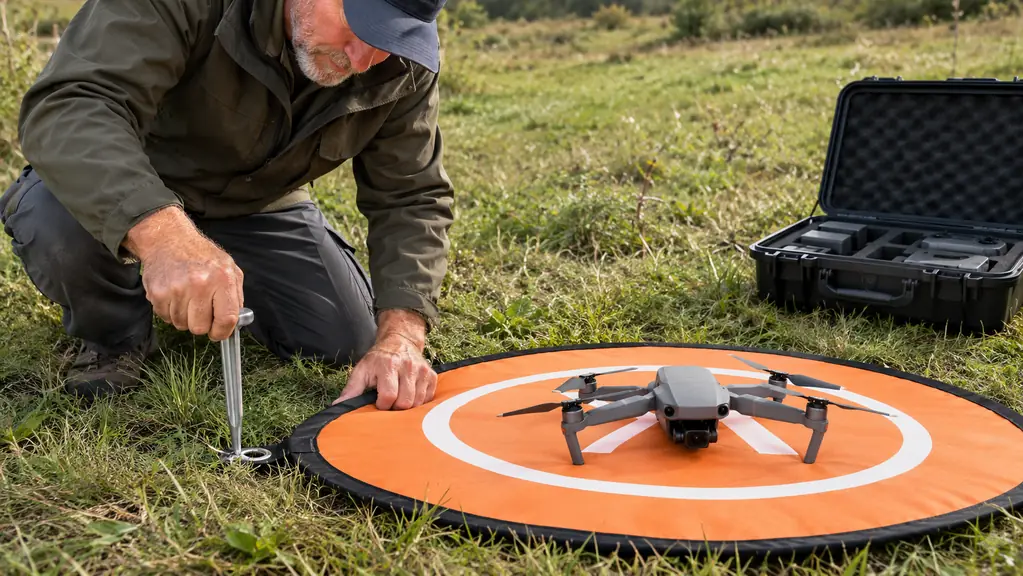
Setup takes about a minute. You unfold it, let it settle, and push the stakes through the grommets. In soft ground the stakes go in with your thumb. In hard, dry summer ground you will be kneeling on them or hunting for a rock. I have learned to carry a small rubber mallet in my work truck, which is the kind of detail the marketing photos leave out. Takeoff is the same every time: set the drone in the center of the target, check the compass, and go. Landing is where the pad earns its keep, because the drone has a clear, high-contrast spot to aim for.
The Fold Lines Are the First Thing You'll Notice
The YINGJEE pad is foldable, which is its best feature and its most annoying one. It folds down small enough to slide into the side pocket of a drone bag, and that is the only reason I carry it everywhere. But folding also means the pad arrives with creases, and those creases never fully disappear. No matter how long you leave it weighted down on the garage floor, it will always have a slight memory of being folded. The fabric relaxes a little over time, but it never lies perfectly flat on its own.
Does that matter? On grass, not really. The pad settles into the grass and the fold lines disappear under the weight of the drone. On a hard surface like a picnic table or a concrete pad, the creases can rock the drone slightly when it touches down. I have never had a tip-over because of it, but I have watched the Mini wobble on landing and catch itself. If you fly mostly from pavement, a flat piece of plywood is honestly a better landing surface. The YINGJEE pad is built for the field, not the driveway, and judging it on concrete is missing the point.
Wind Is the Real Problem, and the Stakes Are Only Part of the Fix
Here is what nobody tells you: a 22 inch landing pad is a sail. It does not weigh much, and in a gust it will lift, flap, or slide across the ground. The included stakes help, but they are small. They bite well into soft grass or loose dirt. They do not bite into hard-packed ground, and they do nothing on a smooth surface like a boat deck or a concrete slab. I have seen reviewers complain that the pad blows away, and they are right. The fix is not a better pad. The fix is staking it down and adding a rock when the ground will not cooperate.
I learned this the hard way last spring. I set the pad up on a gravel lot near one of the north Idaho lakes, did not bother with the stakes because the ground looked firm, and turned around to pull my controller out of its case. A gust came off the water, the pad flipped over twice, and I spent the next ten minutes chasing it across the gravel while my wife Tara watched from the tailgate and did not offer to help. Now I stake it down every single time, even in what looks like calm air. If the ground is too hard for the stakes, I put a rock on each corner. It is not elegant, but it works, and it takes about thirty extra seconds.
The pad has never once failed to do its job. It has also never once lain perfectly flat. Both of those things are true.
What It Actually Does Well
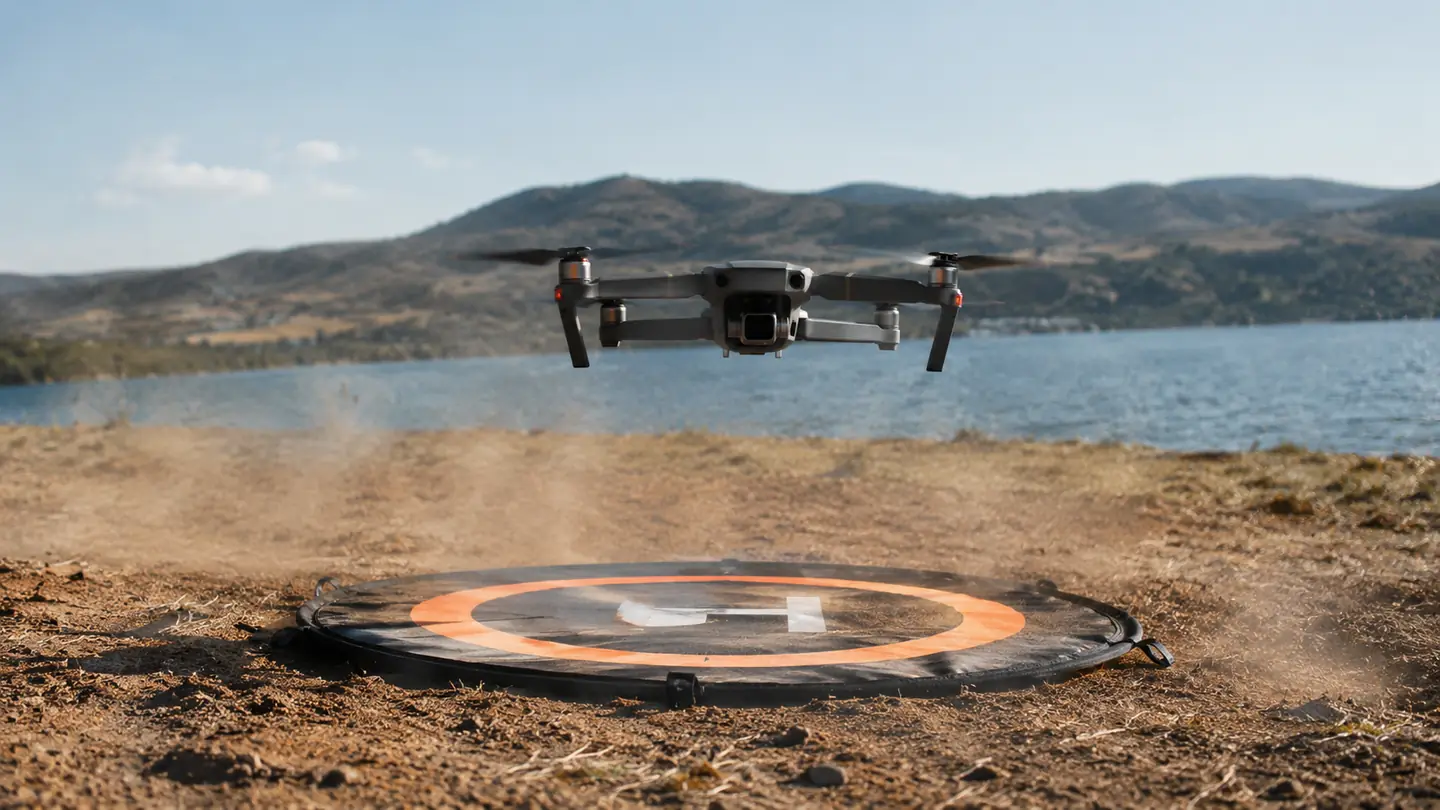
Let me be clear about the good stuff, because it is genuinely good. The pad gives you a clean, dry, level surface in places where no such surface exists. On a dewy morning, it keeps the drone off the wet grass. On a dusty field, it keeps the dust down at the moment of takeoff, which is when the props are closest to the ground and kicking everything up. On a sandy shoreline, it stops the Mini from sucking sand into its motors. That last one alone is worth the price, because sand in a motor means a trip to the repair bench.
The printed target is more useful than I expected. The Mini 4 Pro has a downward sensor, and landing on a high-contrast target gives it a clear reference. I have also found that having a fixed visual marker helps me land in the same spot every time, which is easier on the battery and easier on my nerves. Because the pad is waterproof, I can wipe it off with a rag or just shake it out and put it back in the bag. After two years of abuse, it still looks like a pad, not a rag, and that is more than I can say for the cardboard box lid I used before I bought it.
One more thing that surprised me: the pad works in snow. Last winter I flew from a frozen field near the park, and the pad kept the Mini from sinking into the crust and kicking snow into the gimbal. The waterproof fabric shrugs off the melt, and the printed target stays visible against the white. I did not buy the pad for snow, but it turned out to be one of the best winter accessories I own.
The Details Nobody Mentions
There is no carry bag. The pad just lives loose in my drone case, and it has picked up a few snags from rubbing against the controller and the battery. It has not caused any damage to anything else, but if you are particular about your gear, you will want to wrap it in a grocery bag or a towel. The grommets are metal and they have held up fine, but the stakes are thin enough that I have bent one by stepping on it in hard ground. I straightened it with pliers and it still works, which tells you the stakes are not the strongest part of the kit.
The other detail is that the pad slides on smooth surfaces. On a tailgate or a plastic table, the fabric has almost no grip, and the drone's downwash can push the pad around during takeoff. I have seen the pad shift a few inches while the Mini spooled up. The fix is the same as the wind fix: stakes if the surface allows, rocks if it does not, or just accept that a tailgate landing needs a different approach. None of these are dealbreakers. They are the kind of small annoyances that only show up after you have owned the thing for a while, which is exactly what this review is for.
The Alternatives I Tried (and Still Use Sometimes)
The obvious alternative is hand-catching. I do it when I am flying from a boat or a steep hillside, and it is a useful skill to have. But I do not want to hand-catch every flight. It puts your fingers close to spinning props, it is harder in wind, and it makes every landing feel like a small event. The pad makes landings boring, and boring is what you want when you are packing up in the dark after a long evening flight with the VIFLY strobe blinking on the back of the Mini.
I have also used a piece of plywood, which is flat and free if you have scrap lying around. But it does not fold, it does not fit in a bag, and it is heavy. I have used the tailgate of my truck, which works until you need to fly somewhere you cannot drive. I have used a cardboard box lid, which works until the dew soaks through it. The YINGJEE pad is the only option that is always in the bag, and that is the whole point. A landing surface you do not have with you is not a landing surface. It is just a thing you left at home.
What I Liked
- Folds small enough to live in a drone bag, so it is always with you
- Keeps grass, dust, sand, and dew away from the props and lens
- Waterproof and easy to clean, just shake it out or wipe it down
- Printed target gives the downward sensor a clear reference
- Cheap enough that you do not worry about beating it up
Where It Falls Short
- Fold lines never fully flatten, which can cause a slight wobble on hard surfaces
- Lightweight, so it needs stakes or rocks in any real wind
- Included stakes are small and do not bite into hard ground
- No carry bag included, it just lives loose in your drone case
Who This Is For
Buy the YINGJEE pad if you fly from grass, dirt, gravel, sand, or snow. Buy it if you are tired of cleaning your drone after every flight. Buy it if you want a consistent visual reference for landing, or if you fly from places where there is no clear spot to set down, like a weedy field or a dry lakebed. If you are a weekend flyer like me, this is the kind of cheap accessory that quietly makes every flight better without you noticing. You will not think about it during the flight. You will just notice that your drone is cleaner and your landings are smoother.
Who Should Skip It
Skip it if you only fly from paved surfaces or a table, where a flat board is better. Skip it if you always hand-catch and you are happy with that. Skip it if you fly in strong wind most of the time, because you will spend more time chasing the pad than flying. And skip it if you expect a foldable mat to lie perfectly flat, because it will not. The YINGJEE pad is a tool with a specific job. For that job, it is excellent. It is just not a magic surface, and the sooner you accept that, the happier you will be with it.
The Bottom Line After Two Years
After two years, the YINGJEE pad has earned a permanent spot in my drone case. It has its flaws: the fold lines, the wind, the cheap stakes, the missing carry bag. I would trade all of those for the fact that I have not had to clean grass out of the Mini's arms in two years. If you fly from grass or dirt, this pad will probably earn a spot in your bag too. Just stake it down, carry a rock or two, and do not expect it to lie flat. That is the honest version, and it is still a strong recommendation.
Two years in, I'd still pack it
The YINGJEE pad has a permanent spot in my drone bag. If you fly from grass or dirt, it will probably earn one in yours too. Check today's price on Amazon.
Amazon Check Today's Price on Amazon →